Undressing the Nude — What Ancient Art Really Tells Us About the Female Body
Undressing the Nude
What Ancient Art Really Tells Us About the Female Body
When we look at images of naked women from the ancient Near East or prehistoric cultures, we assume we understand what we are seeing. We do not.
The problem is not the images themselves. The problem is us — or more precisely, the centuries of assumptions, biases, and visual habits we bring to them without realizing it.
The Nude as a Modern Invention
What we call "The Nude" — the idealized, sexualized, aestheticized female body as an art form — is not an ancient concept. It is a product of Post-Enlightenment thinking, shaped by Darwinian theory, Victorian anthropology, and nineteenth-century esthetic conventions that placed enormous value on naturalism and femininity as markers of beauty.
Art historians of the late nineteenth and early twentieth centuries took images of naked women from across all of human history — from the Palaeolithic to the ancient Near East — and read them all through this single modern lens. The result was a massive distortion of what these images actually meant to the people who made them.
The meaning of nudity in the ancient world was not fixed. It was not primarily sexual. It could indicate a mythic moment at the beginning of time. It could signify magical power, priestly purity, legendary heroism, or the presence of a protective spirit. It could mark the dead, the defeated, or the immortal. These meanings were multiple, shifting, and deeply tied to specific cultural and archaeological contexts — none of which are visible to a modern eye trained on "The Nude."
What Prehistoric Nudes Are Really Saying
The famous female figurines of prehistory — including the so-called Venus of Willendorf — have been almost universally interpreted as fertility symbols or representations of a Mother Goddess. This interpretation is not based on evidence. It is based on modern assumptions about what a large, round female body must mean.
When these figurines are looked at critically and in their actual archaeological contexts, a very different picture emerges. They do not form a consistent tradition. They vary enormously across time and geography. Some may represent specific individuals — leaders, shamans, healers. Some may have nothing to do with fertility at all. The insistence on reading them as fertility objects says more about modern scholars than about prehistoric peoples.
The Old Babylonian Nude — A Case Study
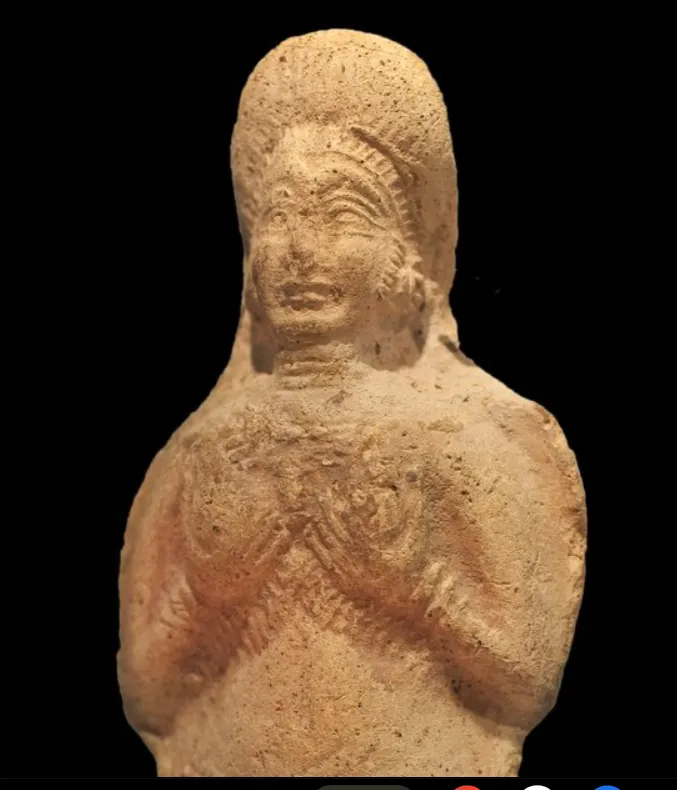
One of the most misunderstood figures in ancient Near Eastern art is what scholars have called the "Nackte Frau" — the Nude Female — a terracotta plaque motif that was ubiquitous in Old Babylonian households between approximately 2000 and 1700 BCE.
Modern scholars have interpreted her in almost every possible way: as a fertility goddess, a prostitute, a cult figure, a seductress, a representation of the goddess Inanna/Ishtar. None of these interpretations hold up under serious examination.
The evidence points in a very different direction. These plaques were not elite objects. They were mass-produced, affordable, and displayed at the entrances and thresholds of ordinary homes — places understood to be particularly vulnerable to malevolent spirits. They were protective objects, tools of folk religion, used to guard the household and promote wellbeing.
The Nude Female in these plaques does not move, does not interact with the narrative scenes around her, and does not display any of the iconographic markers associated with Inanna/Ishtar. She is static, iconic, and object-like — a symbol rather than a living personage. The most convincing identification is that she represents baštu — a Babylonian concept of dignity, personal power, and protective presence. She is not a sexual being. She is a guardian.
Why This Matters
The way we read ancient nude images is not a neutral academic question. It shapes our understanding of the role of women in ancient societies, the nature of ancient religion, and the meaning of the human body across cultures and time.
When we impose modern esthetic and sexual standards on ancient material, we do not illuminate the past — we erase it. We replace what was actually there with a reflection of our own assumptions.
The ancient Near East was not preoccupied with seduction. It was preoccupied with survival, protection, dignity, and the complex relationships between humans, spirits, and gods. Reading their images on their own terms — not ours — is one of the most important and difficult tasks in the study of the ancient world.
It is also one of the most rewarding.