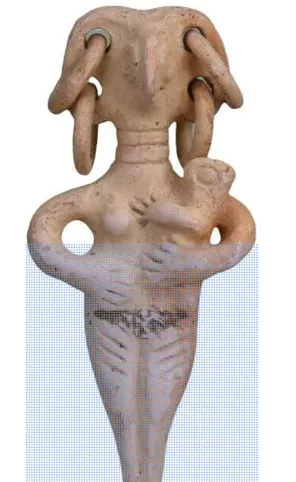
Inside and Out — The Extra-Dimensional Body in Ancient Mesopotamia and Egypt
Inside and Out
The Extra-Dimensional Body in Ancient Mesopotamia and Egypt
What was it like to live inside a body in ancient Mesopotamia or Egypt?
Not what the body looked like. Not how it was depicted in art or described in official texts. But what it actually felt like to inhabit one — to eat, sleep, give birth, fall ill, go to war, and die — in a world where the boundaries between the physical and the non-physical were understood very differently than they are today.
This is one of the most neglected questions in the study of the ancient world. And it may be one of the most important.
The Body as a Multi-Dimensional System
Both Mesopotamians and Egyptians understood the body not as a single unified entity but as a collection of semi-independent parts, each with its own awareness and agency. The heart was the seat of thought, emotion, conscience, and free will. The ear was the organ of wisdom and intelligence — not the brain. To possess wisdom in ancient Mesopotamia was literally to have a "wide ear."
This is not poetic metaphor. It reflects a fundamentally different model of how human beings receive and process knowledge. Mesopotamians appear to have understood wisdom as something received from beyond the self — perhaps from the gods, perhaps from an inner voice — rather than as an innate capacity of the brain. Intelligence was not something you were born with. It was something you cultivated through a kind of receptivity we have largely lost.
Individual body parts were believed to possess their own will and their own life. Cuneiform texts speak of "my heart becoming glad," "my head being lifted high," and "my feet forgetting how to move" — not as figures of speech but as literal descriptions of how parts of the body experienced the world independently.
The Body's Invisible Extensions
Beyond the physical parts, both Mesopotamians and Egyptians recognized a series of invisible forces that inhabited, surrounded, and extended the body.
In Mesopotamia, every person was ideally accompanied by two protective spirits — the female lamassu and the male šēdu. These were not abstract concepts but real presences, believed to walk alongside a person through life, guarding their health, fortune, and physical appearance. Losing them spelled disaster. Prayers and rituals existed specifically to call them back when they had departed in anger.
There was also kuzbu — a concept that combines charisma, allure, and vital force into a single phenomenon. Kuzbu radiated visibly from gods, kings, beloved individuals, and even important objects and buildings. It could be seen. It could be felt. And crucially, it could be stolen — as one first-millennium text describes a witch stealing the kuzbu of a pretty girl with nothing more than a glance.
What are we to make of this? Were Mesopotamians perceiving something real — an auric field, a form of subtle energy — that modern culture has simply lost the vocabulary to describe? The question is worth taking seriously.
The Body's Orifices as Gateways
One of the most striking features of the ancient body was the perception of its openings — mouth, ears, eyes, nose, navel, genitals — as permeable gateways where the visible and invisible worlds could intersect.
The Sumerian word for orifice is the same as the word for door or gate. These were not just physical openings but liminal zones — places of transition and vulnerability where malevolent forces could enter and auspicious forces could be invited in.
This gave rise to an elaborate system of magical and medical practices. Written spells were swallowed. Incantations were licked from the skin. Protective images were placed at thresholds. Amulets were worn over the navel and genitals. The body was understood as a house — with doors that needed guarding.
The Body After Death
Perhaps most striking of all is what both cultures believed happened to the body after death.
In Mesopotamia, the ghost — the etemmu — retained the body's form, features, and needs. It needed food and drink. It needed proper burial to find its place in the community of the dead. An unburied ghost wandered restlessly, causing illness and misfortune among the living.
The dead and the living maintained an ongoing relationship of mutual dependence. The living made offerings, said prayers, and wrote petitions to their deceased relatives. The dead, in return, could intercede with higher powers, remove curses, end droughts, and protect the living from harm.
Death was not an abrupt and final separation. It was more like moving to a distant city — where relatives and friends who had gone before were waiting, and where communication could continue through ritual, dreams, and direct encounter.
This ancient understanding of the relationship between the living and the dead resonates deeply with what I have encountered in over 40 years of work as a medium. The dead do not disappear. They remain present, communicative, and concerned with those they have left behind. What the ancient Mesopotamians encoded in their rituals and texts, I experience directly in my work every day.
Why This Matters Now
The ancient body was permeable, multi-dimensional, and deeply embedded in a web of visible and invisible relationships that extended far beyond the skin.
We have lost much of this understanding. But perhaps not all of it.
Near-death experiencers return with accounts of perceiving the world without a body — with 360-degree vision, without the limitations of physical sight. Children raised in radically different cultural environments develop sensory capacities unknown to those raised in modern Western contexts. Clinical experiments document people perceiving colors through their elbows.
The ancient world was not primitive. It was differently attuned. And the questions it raises about the nature of the body, consciousness, and the relationship between the living and the dead are as urgent and unanswered today as they were four thousand years ago.